
There is much to love about Path of Vengeance, which continues the story of the Evereni cousins, Marda and Yana. And looking solely at the Ro cousins, the novel is a great sequel to Path of Deceit. But things get more convoluted in the context of the High Republic’s larger story and connecting Phase One and Three.
The major thing holding this back from the upper echelons of Star Wars YA novels like Lost Stars, Rebel Rising, and Midnight Horizon is something unexpected: the Jedi.
**Spoilers for Path of Vengeance and Path of Deceit**
The Story
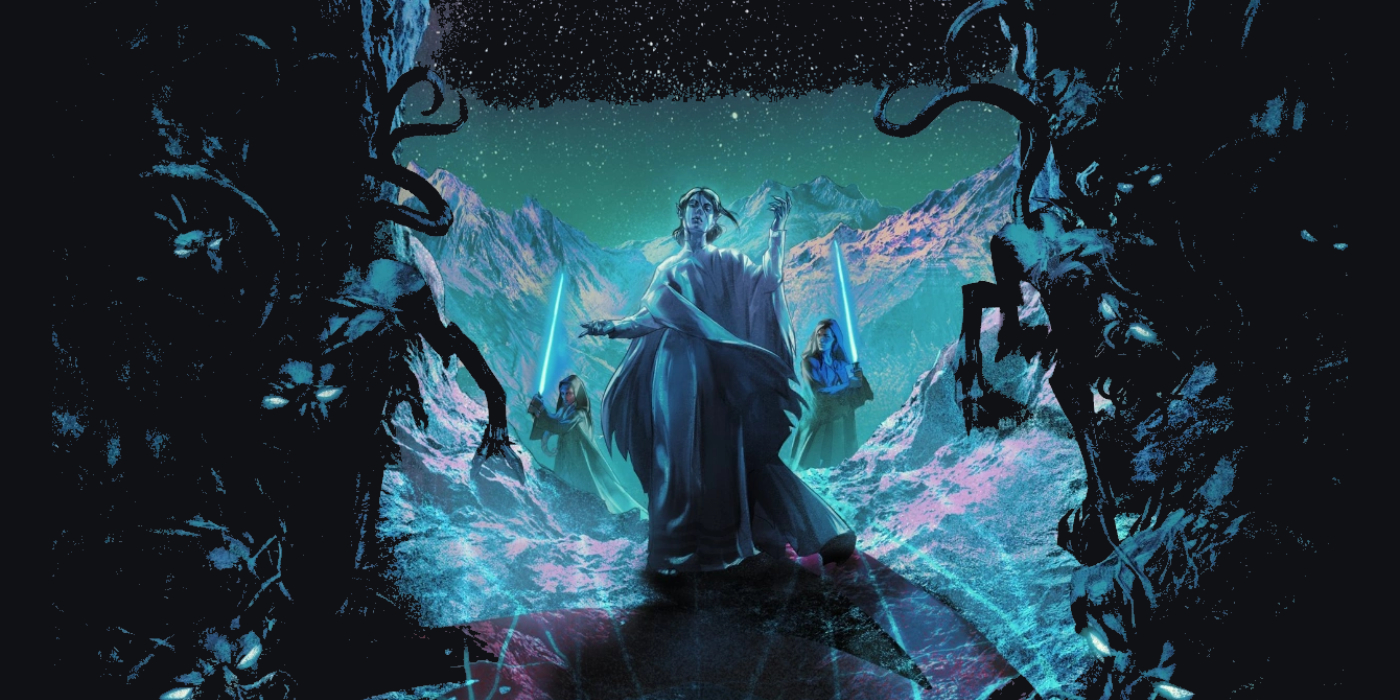
In the wake of the catastrophic Battle of Jedha, Marda Ro feels defeated. Her vision for the Path’s success on Jedha has failed as she desperately searches for the Mother in the wreckage of the battle. While searching, she saves a Path member, Bokana, using her lightsaber to kill someone before reuniting with the Mother.
The Jedi capture the Herald, and when Yana is forced to return to find the Rod of Seasons, she rescues him from the Temple of Kyber (with the help of Kradon from “Tales of Enlightenment”) before returning to Dalna.
On Marda’s suggestion, the Mother broadcasts to the galaxy condemning the Herald for inciting violence and blaming him for the Battle of Jedha. Hoping to get the Jedi off their trail but knowing it won’t, the Path retreats to Dalna to prepare for the inevitability of the Jedi’s arrival. Jedi Knight Oliviah Zeveron and Matthea “Matty” Cathley are sent on a secret mission to get more information on the Path on Dalna. But Matty can sense Oliviah is hiding something from the Jedi.
Meanwhile, Marda, desperate to get back into the Mother’s good graces after Jedha, inserts herself into a dangerous mission to Planet X to retrieve more of the Nameless that can bring the Jedi to their knees.
Twice as long as Path of Deceit, Cavan Scott’s Path of Vengeance culminates the Path’s destructive actions during Phase Two. Divided into three Parts: “The Battle of Jedha,” “The Battle for the Path,” and “The Battle of Dalna,” the story tracks the Path’s evolution and reflects the Mother/Elecia, the Herald, Yana, and Marda’s journeys as they collide on Dalna. And the story flies when it focuses on the Path. But it also suffers from the same weaknesses of novels like Out of the Shadows, dragging out internal politics too long before a rushed third act. And, because this is the last novel of Phase Two, certain character moments come up short, leading to a deflated ending that feels incomplete.
The Characters

Let’s start with the headliners, Marda and Yana, who have consistently been the most endearing characters of Phase Two. They are protagonists within an antagonistic organization and go through the greatest growth navigating that system (for better and worse).
“One day she would free the Force—she knew that, believed it wholeheartedly, in fact—but for now, for the first time in her life, she was truly free. And if anyone tried to tell her otherwise, well, they would reap a whirlwind of their own.”
Cavan Scott. Path of Vengeance. Disney Book Group.
Marda is not ok. She is at her lowest point after the Battle of Jedha and can’t escape her own head. And neither can Kevmo Zink. Yes, the Jedi Padawan who met a horrible fate at the hands of the Leveler in Path of Deceit now haunts Marda as the devil on her shoulder. Quite different from the curious, sweet person from the first release of Phase Two, the ghost Marda sees and hears acts as additional insight into her current psyche.
It is not until Marda arrives on Planet X, and falls in love with another Force-user, Bokana, that she becomes more assured in her leadership abilities and asserts herself over Elecia. In doing so, she becomes terrifying and unyielding in using the Nameless to deal with the Jedi. But she changes her tune when it goes after Force-sensitive Littles (the Path’s children). Marda learns the hard way that evil does not discriminate like she has against the Jedi.
Marda does have some reasonable conclusions about the Jedi Order. It is not wrong that manipulating the Force has had negative consequences. When navigating the Veil (the barrier around Planet X), a Force-user starts freaking out and attracts the planet’s defense system, destroying one ship. And she is right about the Jedi Order taking children away from their families being “particularly cruel.”
Ultimately, Marda puts herself first and ends up alone but happy. You can see how her thinking morphed into the Nihil through generations of interpretation.
Marda’s cousin, Yana, keeps her ties to her past even when it threatens her well-being. Like Marda, Yana sees and hears her former lover, Kor. Unlike Marda, Kor acts more like Yana’s instincts, specifically during her interactions with Kor’s father, the Herald, and the Mother. Despite Kor’s warnings, Yana allows both Path leaders to use her love for Kor to manipulate the Evereni in their quest for power. So it is no surprise to the reader when the Mother, Herald, and even Marda turn on Yana in the third act.
However, Yana does not further isolate herself and forgives Marda enough to work with her to save the rest of the Path and the Jedi. She says her peace to Marda about the Leveler and that it should be destroyed. Overall, Yana recognizes the radicalization of the Path and her cousin and finally distances herself from those connections while strengthening other relationships. And she even makes a Jedi friend.
That Jedi friend is Matty (and she is more of an acquaintance who saved her life). The High Republic comic introduced Matty at the beginning of Phase Two. And even with that early introduction, I still do not feel a sense of who this Padawan is, verses Imri in one Middle-Grade novel, A Test of Courage. Imri had the benefit of having a more intense arc, but the comparison is more for the even balance of character growth for him and Vernestra Rwoh, his eventual Jedi Master.
The best thing that happened to Rooper and Shilandra Sho was separating them from each other, leaving Sho to shine in The Battle of Jedha audio drama and Rooper in Quest of Planet X.
I wish I could claim a similar success for separating Matty from her Master, Vildar Mac. But Matty has little social decorum, often played for humor but is often more grating. She partially finds a way to overcome the effects of the Nameless by uniting the Jedi and facing her fears, but that doesn’t seem to help against the fully grown Leveler. I expect this glimmer of hope against a strong Force creature will play an important role for Jedi in Phase Three.
Matty’s lackluster development through multiple Phase Two mediums is the tip of the iceberg to the restraints of covering part of this High Republic era in two Waves. And it is a double-edged sword for the villains. In Phase One, readers had three Waves to build up antagonists in the Drengir, the Nihil, and the Nameless. But because there are fewer comics, novels, and short stories in Phase Two, the Path of the Open Hand has more active involvement (an exception being The High Republic Adventures). And yet, the mystery surrounding the Mother/Elecia continues until the very end, which gives her nothing more than the “evil for sake of evil” part. Yes, she is Force-sensitive (that becomes clear the longer she is around the Leveler). She uses the mind trick on those around her (including Sunshine Dobbs). But what was the point of having her be related to Jedi Knight Oliviah Zeveron, a character who has been so insignificant to Phase Two that she does not have a single POV paragraph in this novel? We never get inside her head as these events unfold. Tertiary characters like Shea, the engineer with ties to the San Tekkas, get a third-person POV, but everything we learn about Oliviah is from her interaction with other characters. She is pure exposition in a Jedi robe.
It’s sad because, on paper, their story is the type of soap opera drama that plays well for Star Wars: family on opposite sides of good and evil. Elecia even notes that she and Marda are more alike than originally thought.
And, while Elecia finally gets more dimension, it comes far too late. The parallel that could have been drawn between the Jedi Order literally breaking up the Zeveron family and the Path driving a bigger wedge between sister-like cousins Marda and Yana would have made this Phase more personal and special.
Oliviah feels like a character cut significantly during Phase Two development, and, for fans who do not read the comics, her struggles in Path of Vengeance will be even more meaningless.
As for other characters like the Herald, his motivations never found footing. At the end of Path of Deceit, it felt like he was the Mother’s official nemesis for power within the Path and that a grand plan would reveal itself eventually. That never materialized, and the Herald toggled between sides so easily an uneventful death was inevitable. The only clear character trait was his adversarial relationship with Elecia meant more to him than his daughter and wife.
Other characters are sprinkled throughout that play their parts (Bokana is Marda’s second love interest, a Kevmo 1.0 with a less horrible fate) but shows Marda recovering from loss faster as she achieves clarity in herself. Sunshine Dobbs gets time to prove that he might have been a different person under Elecia’s influence. Azlin Rell’s reserved nature contrasts Matty’s boisterousness, but The Edge of Balance Precedent is where that character shines the most.
The upcoming Star Wars: The High Republic: Tales of Light will be an anthology collection of short stories that fill in gaps between and during Phases. It will also likely be the last chance to add context to characters lacking in this Phase.
Canon Contributions
“The Evereni couldn’t see the dead. Once someone was dead, they were gone.”
Cavan Scott. Path of Vengeance. Disney Book Group.
I am not so sure that the Evereni can’t see the dead. While Kor and Kevmo are used to add additional context for Yana and Marda, maybe that is also their way of dealing with demons. Marchion Ro regularly heard his father, Asgar Ro, in his head in Rising Storm, mocking him and his weakness against the Jedi. However, there is no reference to Asgar appearing to Marchion in Fallen Star. Does Asgar still haunt Marchion, or has the Eye completely shut his father’s voice out now that he has momentarily defeated the Jedi?
Also shoved into this packed novel was Shea Ganandra, a highly skilled engineer of the Path who is also Force-sensitive. She is also on the mission to Planet X and figures out how to jump through hyperspace to escape the Veil. Her lover, Geth, supposedly does not make it, and Shea discovers she is pregnant. Yana and Opari leave with Shea, who mentions that if the baby is a girl, she will name her Mari (also Shea’s real name). Names are important in Star Wars and hardly ever coincidence. Shea is Mari San Tekka’s mother, which means either Shea eventually marries a San Tekka or Geth, or Shea is already a San Tekka. We know little about Shea now but could get more information in Phase Three.
On Planet X, the Path team meets two new creatures: the Under-Dweller and the Protector. Most of the planet’s creatures seem hostile to outsiders, although these two threaten everyone, not just Force-sensitives like the Nameless. Will Planet X remain a mystery after The High Republic Phase Three, or will we get more information on the environment of this crazy, Wild Space planet?
Path of Vengeance might have been a better third addition in a trilogy focusing on Marda and Yana while giving more time for some secondary plots. But, as it stands, Path of Deceit and Path of Vengeance are inseparable as a pair of solid additions to Star Wars canon.

 Credits and Canon